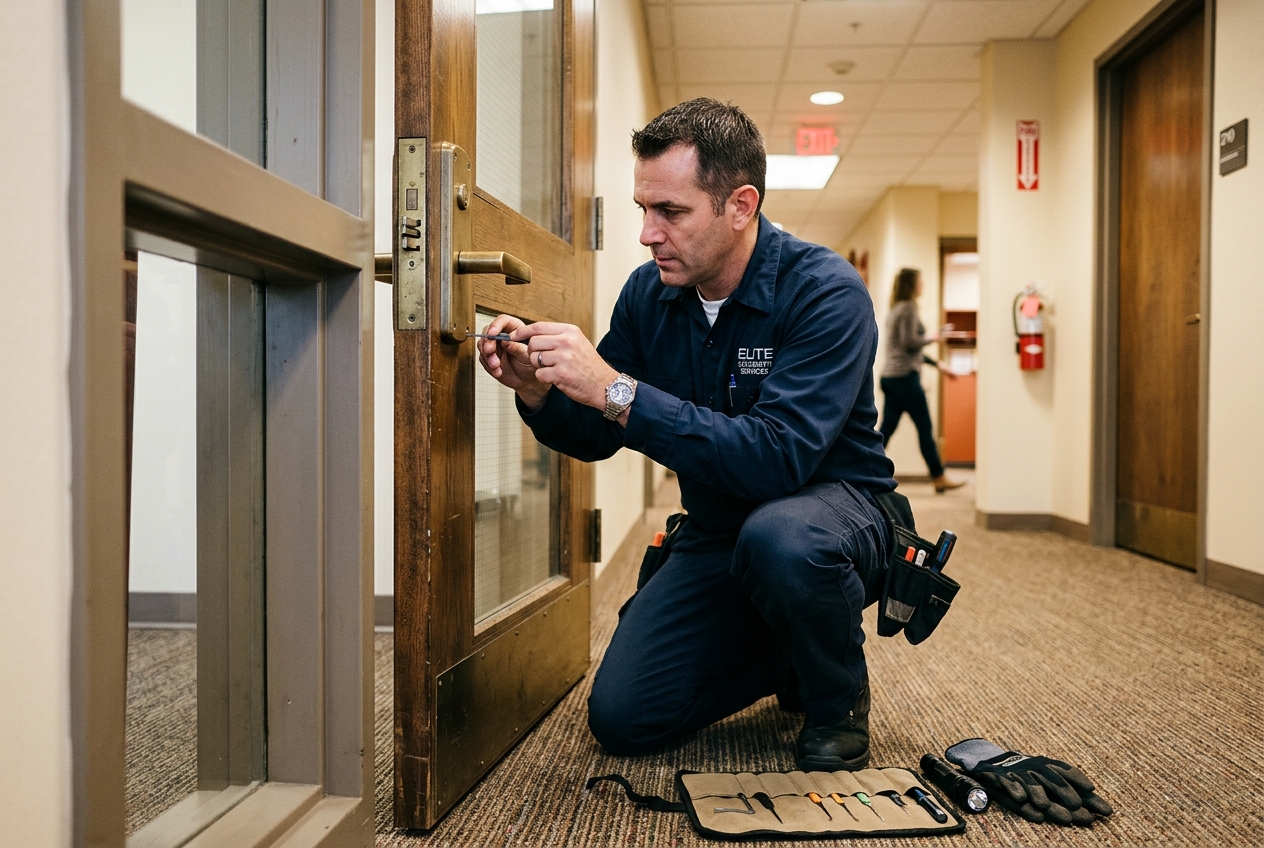
Narrow-stile doors commonly use mortise cylinders, hook bolts, pivots, closers, and precise strike alignment.
Direct answer
What storefront lock repair covers
Storefront Lock Repair covers narrow-stile storefront locks, cylinders, pivots, and related entry hardware. Use this service path when a glass or aluminum storefront door does not lock, latch, or align reliably. The first conversation should identify the exact object, symptoms, location, and authorization rather than treating every call as the same lockout or replacement.
Commercial locksmith work is an access-control decision, not just a hardware swap. Door function, employee roles, key accountability, customer flow, emergency egress, and future changes all belong in the plan.
Storefront Lock Repair: the technical checkpoints
A useful service page should help a caller recognize the decisions behind the work. These checkpoints are specific to storefront lock repair; they are not a promise that one technique or part fits every opening.
A dragging aluminum or glass door should be aligned before a new lock is blamed for difficult operation.
Protect glass and avoid uncontrolled drilling into narrow metal sections with hidden reinforcement or wiring.
Test latch or hook engagement, key removal position, closer action, and the customer-entry flow.
What the technician should inspect
The diagnostic focus is door sag, cylinder and hook-bolt condition, strike alignment, closer action, and safe glass handling. That examination separates a key or credential problem from a cylinder, latch, frame, linkage, electronic, or installation problem. It also reveals whether a repair would be durable or merely postpone another failure.
Ask for the condition to be explained before approving the scope. A sound recommendation names the failed component, identifies anything that can stay, describes the proposed method, and gives the price or a clearly bounded range. If limited disassembly is needed to confirm hidden damage, that boundary should be stated first.
A practical service sequence
- Identify the system.Record the lock, door, key, credential, safe, or vehicle details and the exact symptom.
- Confirm authority.Show reasonable ownership, occupancy, management, or vehicle documentation before access work begins.
- Test the least disruptive cause.Check alignment, wear, power, pressure, user procedure, and visible damage before destructive work.
- Compare the valid options.Review repair, rekeying, credential change, or replacement only where each option actually applies.
- Approve the scope and price.Do not let an urgent call become permission for unrelated parts or work.
- Verify the outcome.Test every relevant key, code, button, latch, lock, and inside release before closeout.
San Francisco access and property details
San Francisco businesses often operate in narrow storefronts, mixed-use properties, managed office suites, older masonry buildings, and high-traffic corridors. Coordinate with the property manager and preserve required egress; a security upgrade must not compromise safe exit.
Share gate or call-box instructions, parking limits, elevator or loading rules, and the name of the person meeting the technician. For a rental, condominium, managed building, storefront lease, or common door, confirm who may authorize a permanent hardware or credential change. A technically possible change can still be inappropriate without property approval.
Storefront Lock Repair FAQ
What should be checked first for storefront lock repair?
Start by identifying door sag, cylinder and hook-bolt condition, strike alignment, closer action, and safe glass handling. That separates the visible symptom from the component or condition that actually needs attention.
How do I describe a storefront lock repair request?
Explain that the request involves narrow-stile storefront locks, cylinders, pivots, and related entry hardware. Include the exact location, what changed, visible labels, and any access restrictions.
When is storefront lock repair the right service?
Use this service when a glass or aluminum storefront door does not lock, latch, or align reliably. A phone description can confirm whether this page matches the real problem before a visit is arranged.
How should completed storefront lock repair be tested?
Repeat the normal operating sequence several times and test every relevant key, code, button, latch, cylinder, or release included in the approved work.
What proof of authorization is required?
For storefront lock repair, expect to show reasonable proof that you own, occupy, manage, or are authorized to access the property, vehicle, cabinet, or safe. If identification is locked inside, discuss another reasonable way to confirm authority before work proceeds.
Describe the lock, key, or access problem
Call with the exact location and service details. Availability and price are confirmed for the real scope, not promised from a generic label.
Call (415) 367-3120